Characterizing Funding for Agricultural Biotechnology Research and Development in Africa
2022-12-15
Authors: Brian Dowd-Uribe, Trevor Spreadbury, and Joeva Sean Rock
Funding for agricultural biotechnology research and development in Africa is an area with little easily accessible data, and few analyses. Financing comes from different private, public and philanthropic entities. Each of these funding streams, however, can be difficult to trace. When available, data are often difficult to access. At least one researcher has tracked down and analyzed a small subset of agricultural biotechnology funding data. Schurman (2018) examined the top Bill & Melinda Gates Foundation Grants revealing $141 million USD of support for the African Agricultural Technology Foundation (AATF), one agricultural biotechnology crop developer in Africa, from 2006-2018. The industry-funded global data repository for genetically modified (GM) crops, the International Service for the Acquisition of Agri-Biotech Applications (ISAAA), currently does not contain data on funding.
To address this gap, the mBio project searched for publicly available self-reported data from known funders of agricultural biotechnology research and development in Africa. These data include United States Internal Revenue Service (IRS) 990 disclosures for the Bill & Melinda Gates Foundation, the Warren Buffett Foundation, the Rockefeller Foundation, the African Agricultural Technology Foundation (AATF) and the Donald Danforth Plant Science Center. The mBio project also gathered self-reported United States Agency for International Development grants, and two publicly-available funding reports from the United Kingdom's Foreign, Commonwealth and Development Office, which detailed financing for the AATF. See below for a full statement of our data collection and filtering methods.
It is important to note that these data only comprise a subset of the philanthropic and public funds directed to agricultural biotechnology research and development in Africa, and do not contain private funding. Nonetheless, together they comprise the most comprehensive publicly available data on agricultural biotechnology research and development funding in Africa to date. These data were first characterized by Grzenda et al (2022). Below we further examine this dataset to highlight some key findings. We also invite others to make their own analyses from the data.
We sorted the funding data into three categories - highly likely, likely and possible agricultural biotechnology funding based on an assessment of funding descriptions in tax records, or via other publicly-available sources. Our sorting methods are described in detail below. We excluded the AATF from these calculations to avoid the double-counting of funds. We identified $182,583,657 of highly likely and $211,448,280 of likely agricultural biotechnology funding in Africa from the public and philanthropic organizations listed above from 2001-2022. Remaining funding to known developers of agricultural biotechnology projects in Africa, but with only general descriptions related to agricultural development, was classified as possible biotech funding, totaling $4,602,815,254 (See Table 1).
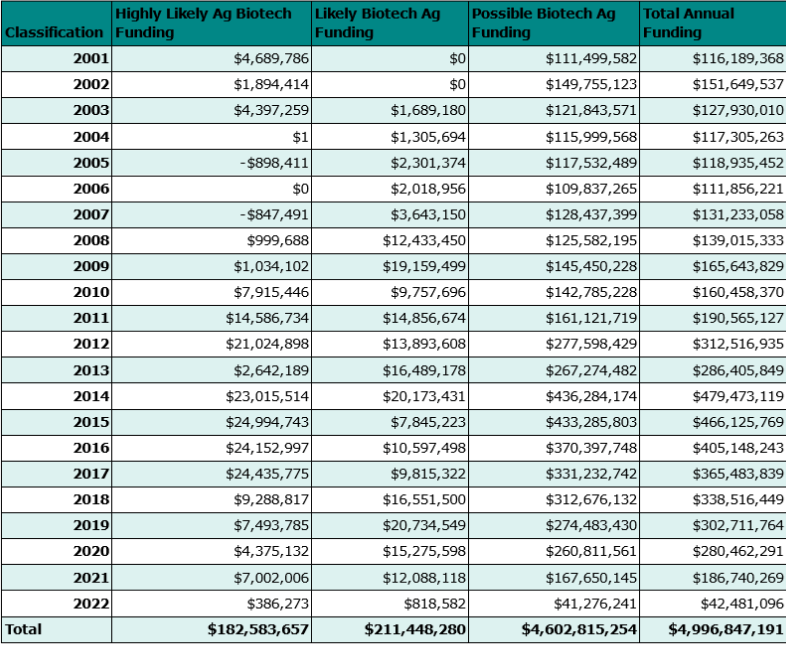
Table 1. Annual funding, sorted by category, for agricultural biotechnology research, development and communications in Africa from the Bill & Melinda Gates Foundation (2010-2019), Howard G. Buffett Foundation (2011-2019), the Rockefeller Foundation (2011-2020), the Donald Danforth Plant Science Center (2010-2019), the United States Agency for International Development (USAID) (2001-2022), the Department for International Development (2008-2020) and the Syngenta Foundation (2008-2014). Additional data were included to complete all funding to the African Agricultural Technology Foundation from the Bill and Melinda Gates Foundation (2003-2009, 2020-2021), Howard G. Buffett Foundation, and the Rockefeller Foundation (2003-2010). Data are incomplete for many years for certain funders due to a lack of availability. Highly likely ag biotech funding includes specific and exclusive mention of a known agricultural biotechnology project in the funding description. Likely ag biotech funding includes grants (a) directed to recipients who use a majority of their funding for agricultural biotechnology projects and/or (b) with a non-exclusive mention of a known agricultural biotechnology project in the funding description. Possible ag biotech funding contains funding to a known agricultural biotechnology project developer but with only a general agricultural development funding description. Low and negative numbers in the highly likely ag biotech funding rows 2004, 2005, and 2007 are as reported by USAID.
The mBio project further focused on one of the key institutions driving agricultural biotechnology research and development in Africa, the AATF, which was developed by the Rockefeller Foundation in the early 2000s to arrange partnerships between biotechnology firms and African scientists to develop GM food crops. Since its inception, the AATF has initiated a number of public-private partnerships to develop, among others, GM rice, maize, and cowpea. It also works to shape reporting on biotechnology on the continent through its communications wing, the Open Forum on Agricultural Biotechnology, and is a leader in the African Union's African Seed and Biotechnology Platform.
Here we focus on the major donors to the AATF, and those who received funding from the AATF for contracting services. From 2008 to 2020, the AATF reported via IRS 990 disclosures that it received a total of $225,031,701 in contributions. However, tracked contributions from known AATF funders revealed total AATF funding over that same time period to be $273,791,640. The reason for these funding discrepancies is unclear. The top donor for the AATF was the Bill & Melinda Gates Foundation with $142,851,973, followed by USAID with $96,983,701 (see Table 2 and Figure 1).
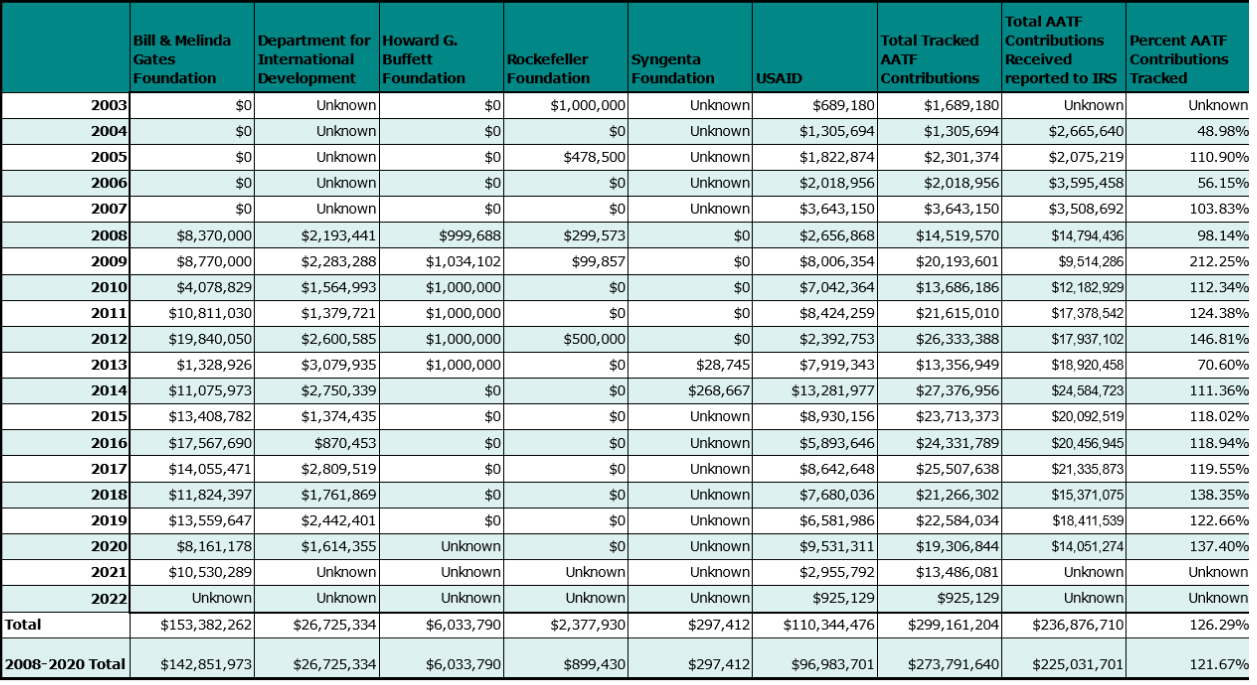
Table 2. Tracked contributions to the African Agricultural Technology Foundation (AATF) from its major public and philanthropic donors, 2003-2022.
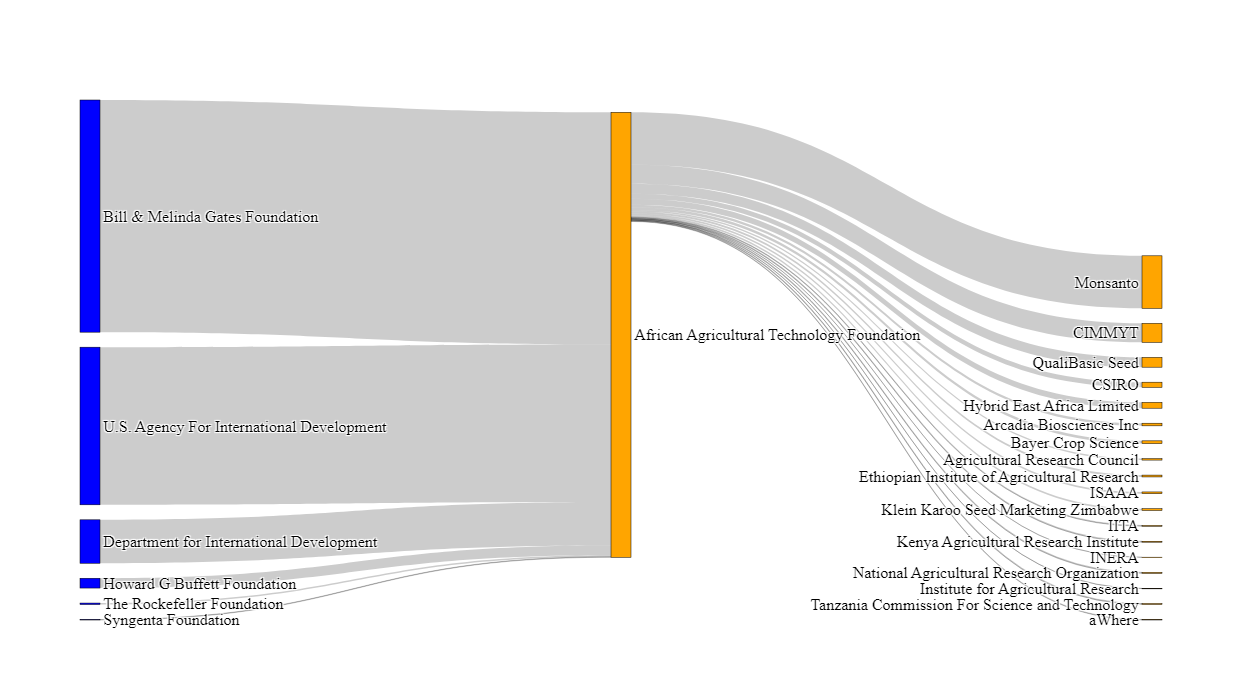
Figure 1. Tracked contributions to the African Agricultural Technology Foundation (AATF) from six public and philanthropic organizations, 2008-2020 (left). Tracked payments from the AATF to contractors as self-reported to the United States Internal Revenue Service (IRS), 2008-2020 (right). Data are limited for contractor payments given that the IRS only requires annual reporting for the top five highest compensated contractors receiving funds in excess of $100,000.
The AATF's top contractor was Monsanto, recently purchased by Bayer in 2018. Between 2008-2020, the AATF made $45,940,909 in contractor payments to Monsanto, which comprised 20.41% of the total contributions the AATF received over that same time period. According to IRS 990 disclosures, these expenditures were for project development work related to the Water Efficient Maize for Africa (WEMA) and TELA maize projects. Both projects are public-private partnerships between several African research institutions, the International Maize and Wheat Improvement Center (CIMMYT), and Monsanto.
In projects such as WEMA and TELA, the AATF has described their relationships with biotechnology firms as partnerships, where firms like Monsanto donate technology and services (AATF 2011; Boadi and Bokanga 2007). In both referenced cases, Monsanto, and later Bayer, licensed genetic traits for crop development (AATF 2021). For this reason, the contractor payments to Monsanto stood out, as it suggests that these relationships may be more dynamic than previously understood.
Analyzing the funding flows of one actor, AATF, reveals the complexities of this sort of research, and the necessity to draw from different methods and areas of expertise. The work to better understand agricultural biotechnology research and development funding on the African continent is far from complete. Nonetheless, we hope that this analysis and these data begin to fill a significant knowledge gap on this topic, and will be of interest to researchers, scientists, officials, and many others.
References
African Agricultural Technology Foundation (AATF) 2011. Water Efficient Maize for Africa (WEMA) Progress Report 2008-2011. Accessed on 11 December 2022. Available at: https://www.aatf-africa.org/wp-content/uploads/2021/02/WEMA-Progress-Report_2008-2011.pdf
African Agricultural Technology Foundation (AATF) 2021. TELA Maize Technology, FAQs All You Need to Know. Accessed on 11 December 2022. Available at: https://www.aatf-africa.org/wp-content/uploads/2021/02/TELA-Project-FAQ.pdf
Boadi RY and M Bokanga. 2007. The African Agricultural Technology Foundation Approach to IP Management. In Intellectual Property Management in Health and Agricultural Innovation: A Handbook of Best Practices (eds. A Krattiger, RT Mahoney, L Nelsen, et al.). MIHR: Oxford, U.K., and PIPRA: Davis, U.S.A. Accessed on 11 December 2022. Available at: https://www.aatf-africa.org/wp-content/uploads/2021/02/ipHandbook-17.pdf
Grzenda, D., Spreadbury, T., Rock, J., Dowd-Uribe, B. and Uminsky, D., 2022. OMGMO: Original Multi-modal Dataset of Genetically Modified Organisms in African Agriculture. In International Conference on Social Informatics (pp. 414-425). Springer, Cham.
Schurman, R., 2018. Micro (soft) managing a 'green revolution' for Africa: The new donor culture and international agricultural development. World Development, 112, pp.180-192.
Cite this as: Dowd-Uribe, B., Spreadbury, T., and Rock, J.S., 2022. Characterizing Funding for Agricultural Biotechnology Research and Development in Africa. 15 December 2022, Available at: https://mbioproject.org/blog
Financial Dataset Methods
- We compiled a list of known funders of agricultural biotechnology research and development in Africa via an examination of existing media and public reports. This list contained:
- Bill & Melinda Gates Foundation
- Howard G. Buffett Foundation
- The Rockefeller Foundation
- Donald Danforth Plant Science Center (DDPSC)
- United States Agency for International Development (USAID)
- Department for International Development (DFID; UK)
- African Agricultural Technology Foundation (AATF)
- To characterize the agricultural biotechnology funding from these organizations, we compiled data from various publicly-available sources. We plan to supplement these data from further sources as they become available.
- For IRS 990 data, we used ProPublica's Nonprofit Explorer for the years in which Raw XML data is available. For Bill & Melinda Gates Foundation (BMGF), DDPSC, and AATF this is 2010-2019; for Howard G. Buffett Foundation this is 2011-2019; for Rockefeller Foundation this is 2011-2020. These data contain information on incoming and outgoing transactions that meet certain criteria defined by the IRS.
- BMGF, Rockefeller, Buffett are private foundations (990 PF) and are required to list all contributions and grants paid yearly. AATF and DDPSC as public charities are only required to report total annual contributions.
- We used the USAID website for self-reported USAID grants from 2001 to 2022.
- We used the Foreign, Commonwealth and Development Office's Development Tracker to find reporting on grants from DFID to AATF (2010-2020).
- This is the only data we received in GBP and not USD. We converted using rates at the date of the transaction with CurrencyConverter
- Manual Sources:
- We used the DFID AATF Programme Completion Report 2014 to find summary data from 2008 and 2009 for DFID grants to AATF, and Syngenta Foundation contributions to AATF for 2008 to 2014. For years and sources where more detailed data were available, we used those data in place of this source.
- We used PDFs of IRS 990-PFs to manually extract grants made by BMGF, Rockefeller, and Buffett to AATF for certain years (BMFG: 2003-2009, 2020-2021; Rockefeller and Buffett: 2003-2010) in which the PDFs were available, but Raw XML was not.
- For IRS 990 data, we used ProPublica's Nonprofit Explorer for the years in which Raw XML data is available. For Bill & Melinda Gates Foundation (BMGF), DDPSC, and AATF this is 2010-2019; for Howard G. Buffett Foundation this is 2011-2019; for Rockefeller Foundation this is 2011-2020. These data contain information on incoming and outgoing transactions that meet certain criteria defined by the IRS.
- These data were then filtered by recipients, searching only for institutions that are known developers of agricultural biotechnologies in Africa (as per the mBio project GM Crops Database). This search only included exact name or abbreviation matches, and therefore may miss transactions in our larger dataset with nonstandard names for organizations. Improving this matching process is an area of future work.
- These data were then further filtered to include only those transactions that were directed towards agricultural development. Potentially non-agricultural development-oriented funding were excluded based on vague or non-determinant funding descriptions (e.g. titles like "rural livelihoods", "economic development" were excluded). Funding descriptions that contained terms that were more directed to agricultural development and/or biotechnologies were included (e.g. agricultural biotechnology/development/growth/policies/production/productivity/research/sector; nutrition; food commodities/crops/policy/security; biotechnology; legume; cassava; potato; maize; cowpea; rice; banana; WEMA)
- The remaining lines are now present in our searchable online data set and comprise funding that is possibly related to agricultural biotechnology research and development in Africa.
- These data were then further filtered into two additional categories based on an analysis of funding descriptions.
- Highly Likely Biotech Funding. This categorization includes funding with:
- Explicit and exclusive mention of biotech funding in funding description, OR
- Explicit and exclusive mention of a known biotech research, development and/or communications project in the funding description (without mention of 'biotech')
- Likely Biotech Funding. This categorization includes funding with:
- Mention of "biotechnology" in the funding description but does not appear to be the exclusive purpose of the grant, OR
- Mention of funding to an entity with either:
- (a) a known majority (more than 50%) of funding from donor to recipient is explicitly for biotech research (e.g. as described via BMGF grantees descriptions), OR
- (b) a majority of funding (more than 50%) of recipient resources go towards biotech research (e.g. BMGF and Rockefeller Foundation $$$ for AATF; USAID funding for AATF, Syngenta Foundation funding for AATF).
- Possible Biotech Funding. This categorization contains all remaining funding.
- Highly Likely Biotech Funding. This categorization includes funding with: